

Portable Drill Rig for Mineral Exploration
An exploration hole is a question rather than an answer. It exists to find out what sits beneath a geochemical anomaly, a geophysical target or an old working, and most of the time the answer is a few metres of weathered rock and nothing worth following. That economics shapes the machine. A portable drill rig for mineral exploration is bought for how cheaply it answers many small questions in difficult country, and the depth rating is close to irrelevant when the target sits twenty metres down.
What the hole has to prove
Three things have to be true before a hole has value. It must reach fresh bedrock, because soil and weathered rock say little about the mineralisation below. It must reach enough of it to be representative, and programmes commonly specify a few metres of unweathered rock below the interface as a working convention. And the sample must arrive uncontaminated and correctly logged, since an assay is only as good as the material in the bag.
Those requirements put the emphasis on the overburden-to-bedrock transition, on sample handling, and on how fast the rig can be moved to the next site.
Overburden, not depth, is the binding constraint
Our LE90R quotes 100 m with NW casing, a 92 mm spindle bore and a 500 mm feed stroke. On an exploration programme those numbers matter only through one question: how thick is the cover?
If the overburden is five metres, the casing job is five metres and the rest of the hole is core. If it is twenty-five metres of running sand, the casing job is most of the hole and the rig spends its day on a task that produces no sample. That is why the honest way to compare one portable drill rig for mineral exploration with another is cover thickness and hole count, rather than a maximum depth no shallow programme will approach.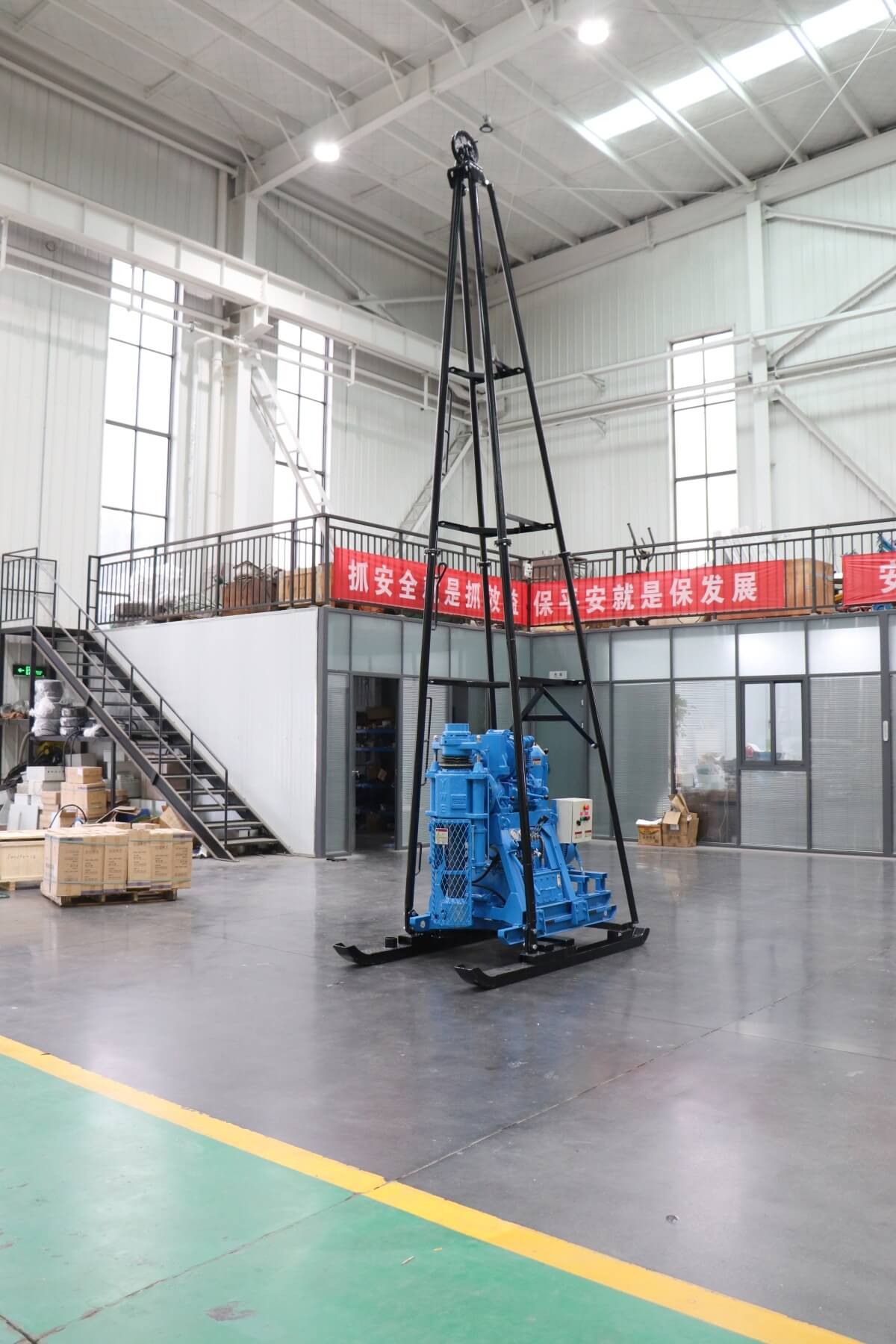
Clean samples are made on site
Contamination and core loss are both created at the rig, and neither can be corrected in the laboratory. The interval immediately below the casing is the vulnerable one: soil that falls from the casing shoe, drilling water carrying fines, and rust or grease from the string all report as grade if the first run is handled carelessly.
The mechanics of this machine put a premium on handling discipline. The chuck is a manual three-jaw type and the feed stroke is 500 mm, so the string is re-chucked every half metre, and each of those is a moment when core can be dropped, mixed or logged late. A crew that logs and boxes at the collar as the run comes up protects the sample; a crew that leaves core in the tube until the end of the shift does not.
Portable, measured honestly
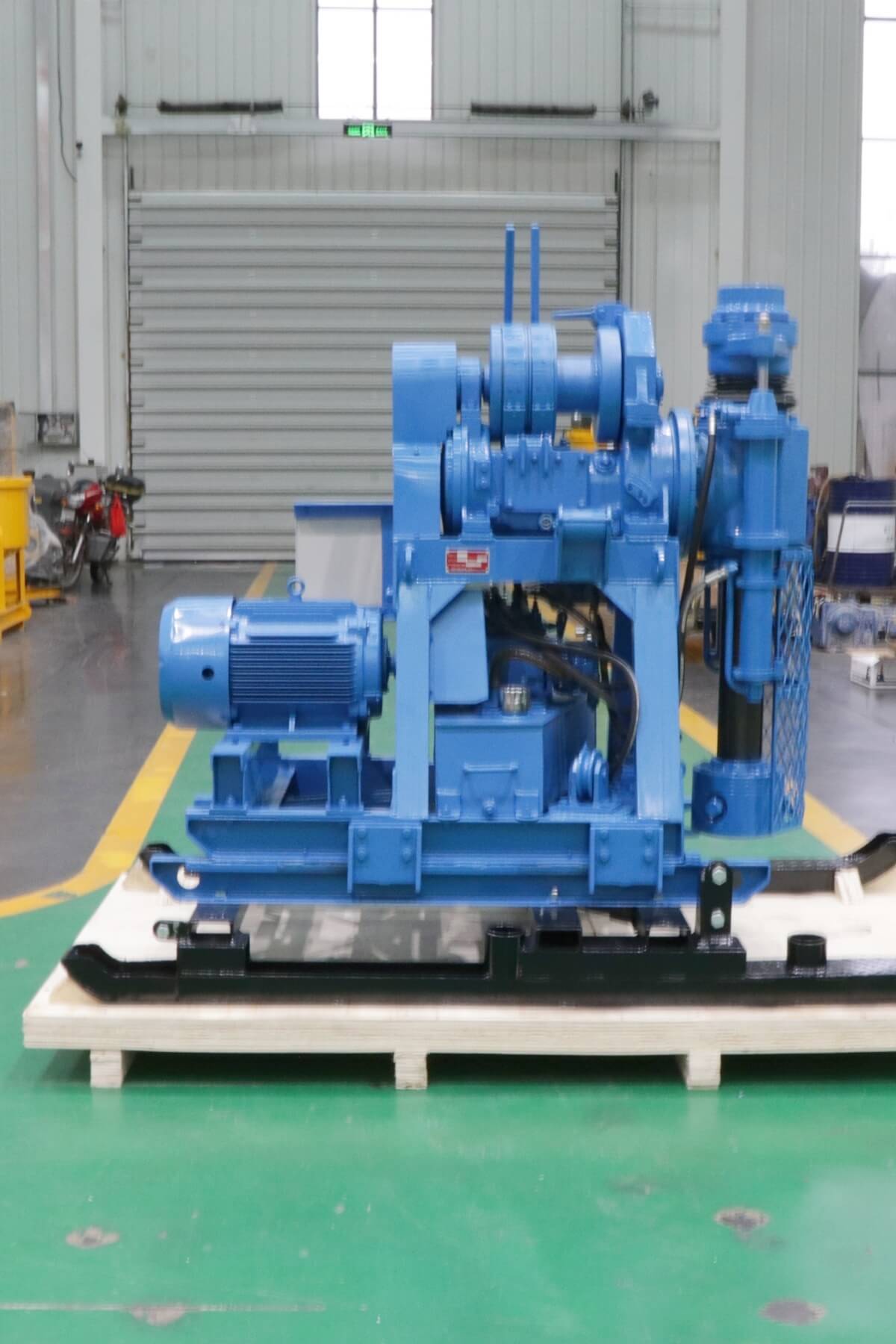
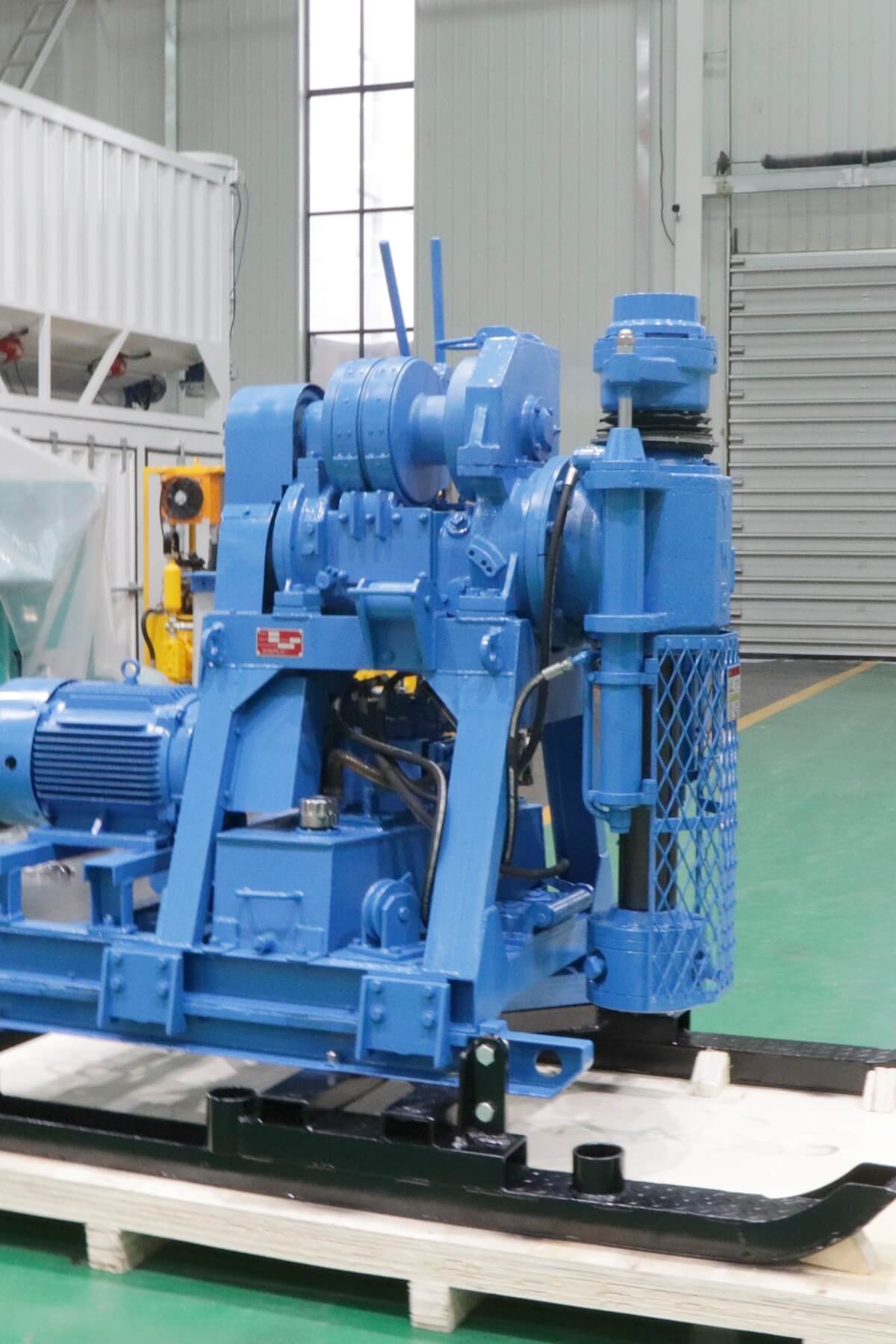
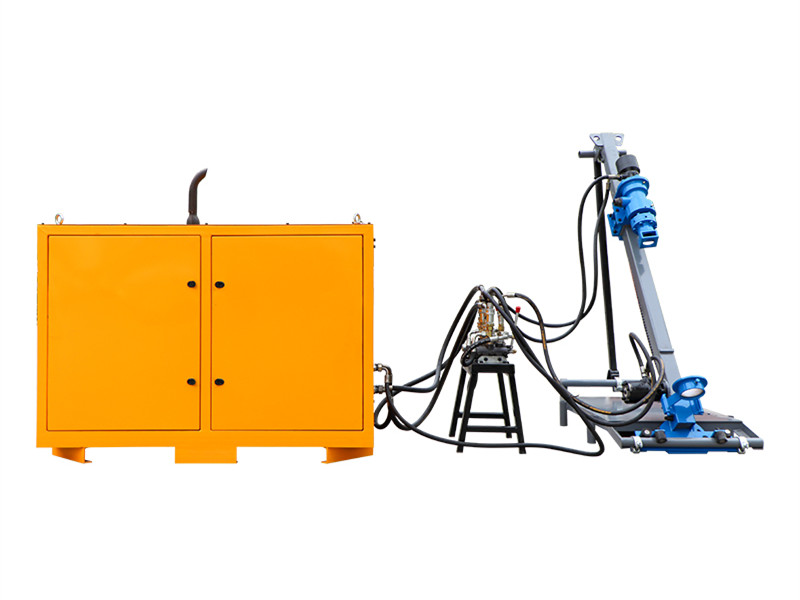
Portability is the claim every supplier makes and almost none defines. This machine weighs 1,300 kg complete with skid and engine, and the mast is a separate 170 kg assembly of 60 mm and 48 mm steel tubes, braced at three levels.
That combination gives a clear boundary. The mast can be lifted off and carried by hand, and the skid can be dragged on its three pulleys or towed behind a quad or a light vehicle. What it cannot be is carried up a hillside by four people. Where access is a footpath, a helicopter or a mule track, a portable drill rig for mineral exploration has to be a different class of machine, and no amount of field ingenuity changes 1,300 kg.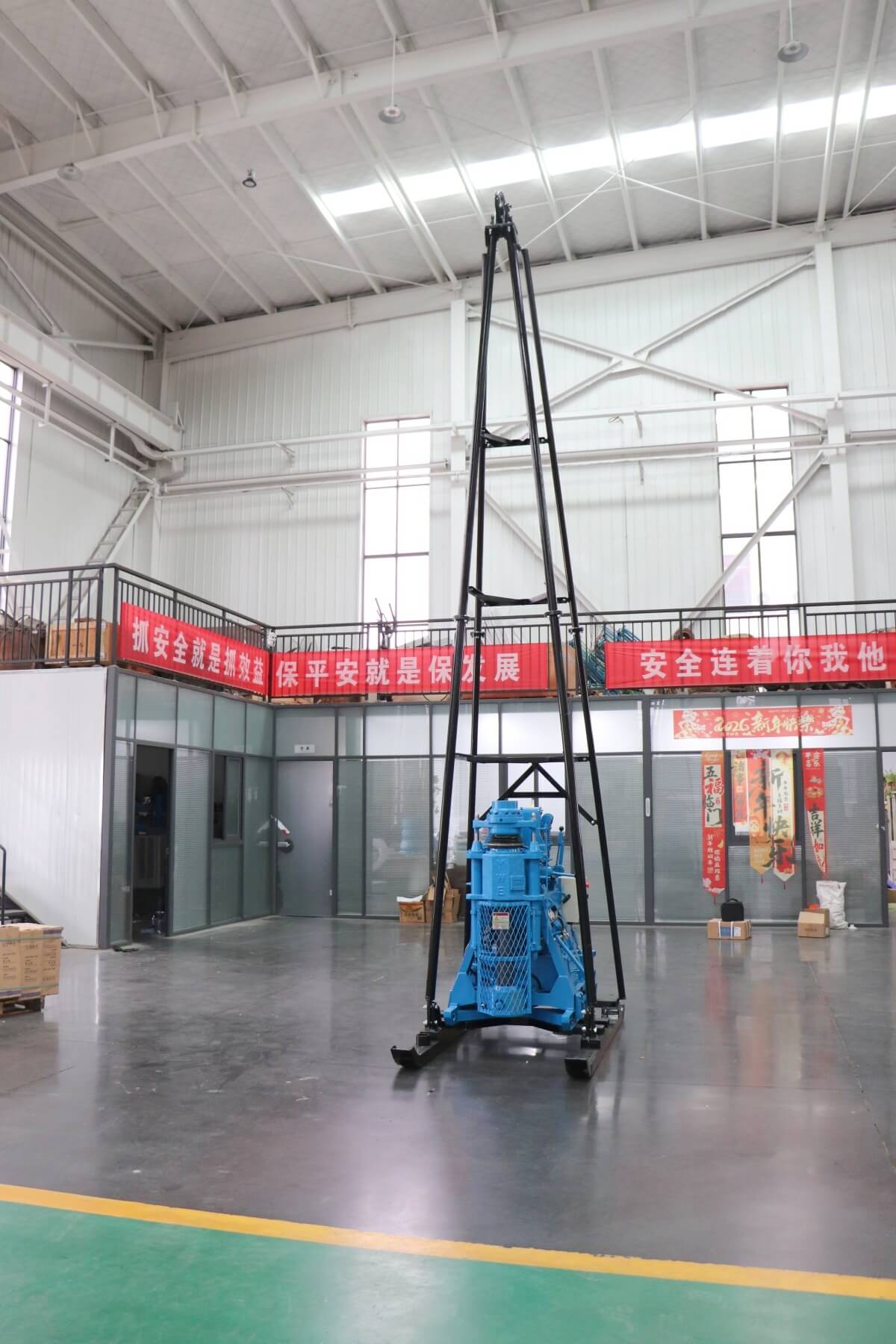
The arithmetic that should set the price
Twenty holes at twenty metres each comes to 400 m, which sounds like a week of drilling and is usually two weeks of work. Each hole needs seven rods and about forty re-chucks. Each one also needs a move: tow into position, level the skid, raise a 5.75 m mast, anchor, drill, lower, move on.
If a move costs forty minutes and drilling costs ninety, a third of the field day goes to relocation, and the buying decision belongs to that third. On a portable drill rig for mineral exploration, ten minutes saved per move is worth more across a twenty-hole grid than a higher depth rating, which is the argument for a 1,140 mm wide skid and a mast that goes up quickly.
Where this rig is the wrong purchase
Four cases. Resource definition drilling, where oriented core and triple-tube recovery are specified, needs a different head and rod handling. Holes beyond the stated capacity, or PQ sizes, are out of reach. Ground where the skid cannot be towed at all needs a carried or helicopter-transportable unit. And a programme drilling through deep alluvium to reach a target below it is really a water-well or rotary problem, not a coring one.
What to send with an enquiry
The target type and the evidence behind it; expected overburden thickness and its behaviour; planned hole depth and diameter, plus the core size required; hole count and spacing across the programme; terrain and access, including whether a vehicle can reach each collar; water and power available; the logging and sampling procedure you work to; and whether oriented core is needed. Send these to sales1@leadcrete.com.